Tutorial: Application Log Router
This advanced tutorial turns two application-log shapes into one governed stream. Invalid records go to quarantine; valid records are cloned to a durable full archive and a critical-event evidence branch.
Outcome and topology
Section titled “Outcome and topology”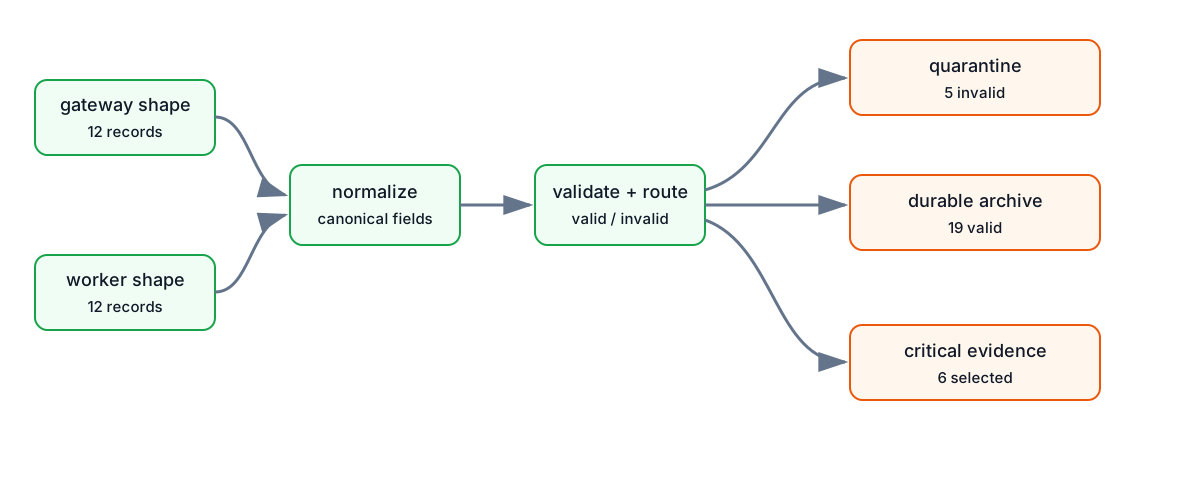
gateway JSONL (12) -- normalize --\ validate -- conditional valid/invalidworker JSONL (12) -- normalize --/ | | | +-> quarantine (5) +-> clone archive -> durable store (19) critical -> filter -> evidence (6)Fixture contract
Section titled “Fixture contract”d07fba52217352f5cfae52fe8affbd4f7abbc5f20371ed2f75cc99bae04a5895 gateway.jsonl7f0a18e74a23ce431d5386a17d8d993f860cfc50e287c27ae515d9e790d541cd worker.jsonl421e9e5050bafc3e55756059ec28adf57522098b521dc5ac2675d23e90c23a9b expected-summary.jsonAll data is synthetic. Copy both JSONL files to fresh run-owned paths visible to the source worker.
Normalize the source shapes
Section titled “Normalize the source shapes”Create two finite Files source paths. Gateway records already use
source, severity, and message. Map worker fields as follows while
preserving event_id and timestamp:
| Worker field | Canonical field |
|---|---|
component |
source |
level |
severity |
text |
message |
The canonical required fields are event_id, timestamp, source,
severity, and message.
Validate and route
Section titled “Validate and route”- Mark a record valid only when all five required fields are present and non-empty.
- Add a conditional routing step with
validandinvalidports. Send missing/unmatched values toinvalidrather than dropping them. - Send
invalidto a run-owned quarantine file/evidence sink. - Send
validto a clone step witharchiveandcriticalports. - Use a durable file-store edge and archive sink for
archive. - Put the predicate
severity == "critical"on thecriticalbranch and write it to a separate local evidence sink. - Validate the graph and inspect both dispatch definitions in the manifest.
Placement and storage
Section titled “Placement and storage”For the first proof, use one worker group and co-locate local paths, worker channels, file-store writer, and reader/evidence jobs. If you later split placement, move the durable boundary to a genuine shared mount or object store and prove every worker’s access. Do not treat the same path string on two hosts as shared storage.
Publish, plan, and apply
Section titled “Publish, plan, and apply”Publish the reviewed workflow, create a run-owned deployment, and plan it. Review generated jobs/transports, one-group placement, replica intent, credentials, path permissions, warnings, and teardown scope. Record immutable identities, then apply the unchanged fresh plan.
Acceptance evidence
Section titled “Acceptance evidence”| Check | Expected |
|---|---|
| Input records | 24 |
| Valid archive records | 19 |
| Quarantine records | 5 |
| Critical records | 6 |
| Unexplained loss | 0 |
| Unexpected duplicates | 0 |
The critical IDs must be gw-002, gw-006, gw-010, wk-001, wk-005,
and wk-009. Verify archive and quarantine are disjoint and together contain
all 24 input IDs.
MCP automation path
Section titled “MCP automation path”Follow Author and Deploy Workflows with MCP. Ask the assistant to report the canonical schema, both routing decisions, transport/placement/storage boundary, expected arithmetic, proposed writes, and cleanup identities. Keep preview in read-only; approve upsert, publish, create, plan, and apply separately in the write-tier session.
Optional external HTTP branch
Section titled “Optional external HTTP branch”Replace the local critical evidence sink only after the base proof passes. Use a managed credential reference—not a raw header in the workflow—plus a run correlation field and destination namespace. After runtime success, query the destination and prove the six IDs. An HTTP status or worker log alone is not acceptance. Remove the exact external run-owned objects during teardown.
Failure and recovery
Section titled “Failure and recovery”- Arithmetic fails: preserve artifacts and reconcile every input ID across archive/quarantine before retrying.
- Archive exists but reader is empty: check shared-storage truth, path permissions, completion visibility, and placement.
- Critical count is wrong: inspect normalized severity values before the filter.
- Duplicate records: check source fingerprints, source/reader replicas, retries, and sink idempotency.
- Apply interrupted: inspect proposal/status/events before any retry; re-plan only when the current state is understood.
Teardown and second cycle
Section titled “Teardown and second cycle”Preview cleanup, then remove exact recorded deployments, jobs, channels, groups, workflow drafts, local files, and optional external objects. Re-list all run-owned surfaces and require zero residue. Start a new cycle with a fresh prefix and paths; it must reproduce the same 24/19/5/6 arithmetic.