Tutorial: Local Fan-out
This tutorial is the smallest useful branching proof: every event goes to an
all branch, while three events also pass an important filter.
Expected result
Section titled “Expected result”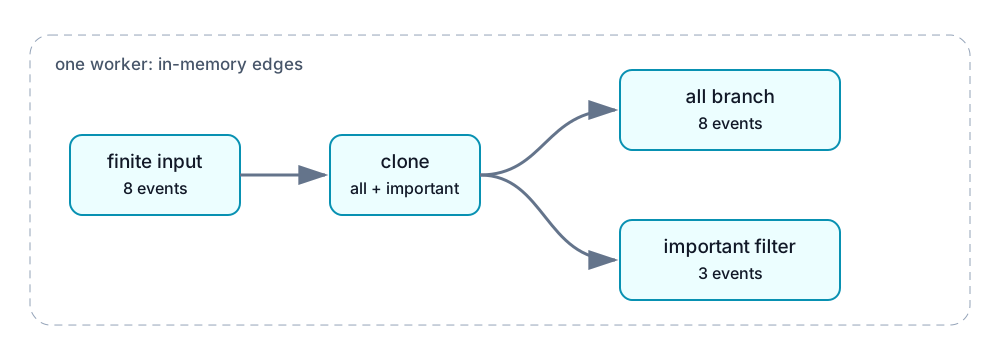
finite files input (8) -> normalize/classify -> clone all -> print-all (8) important -> filter(true) -> print-important (3)The expected important IDs are evt-002, evt-004, and evt-006. Loss and
unexpected duplicates must both be zero.
Download and verify the fixture
Section titled “Download and verify the fixture”sha256sum events.jsonl expected-summary.jsonExpected SHA-256:
61e1b02f658f45a0d474747aa33d22a83054731f46d894dfe0e35d32f3aeb697 events.jsonl7997e8faab01dcf9a29cba755bca3ae59e91e2ae38b2afaaf786e6a1c4df327a expected-summary.jsonCopy events.jsonl to a run-owned directory readable by the selected worker.
Use a fresh path or reset file fingerprints before a second cycle.
Build the workflow in the UI
Section titled “Build the workflow in the UI”-
Create a workflow draft named with a unique prefix, for example
tutorial-local-fan-out-01. -
Add a finite Files source with JSON parsing and Stop reading after enabled. Bind it to the exact worker-visible fixture path.
-
Add any normalization/classification step needed to retain
event_idand the booleanimportantfield. -
Add the built-in Fan Out primitive.
-
Add two output ports named
allandimportant; chooseclonedispatch. -
Connect
allto a Print/evidence sink. -
Connect
importantto a filter whose predicate is exactlyimportant == true, then to a second Print/evidence sink. -
Inspect the manifest and confirm the dispatch expresses clone intent:
[steps.route.dispatch]mode = "clone"ports = ["all", "important"] -
Validate and publish the immutable workflow version.
Plan and apply
Section titled “Plan and apply”- Create a run-owned worker group containing exactly one serviceable worker.
- Create a deployment from the published version.
- Place every generated job in that group; worker-channel edges require co-location.
- Plan and review the generated jobs, channel drivers, one-worker placement, replica count, fixture path, and absence of unrelated destructive changes.
- Record workflow, group, deployment, and plan identities, then apply the fresh plan.
Prove the result
Section titled “Prove the result”Wait for readiness, then correlate worker logs or captured evidence with the deployment and cycle:
| Check | Expected |
|---|---|
| Input records | 8 |
all branch records |
8 |
important branch records |
3 |
| Unexplained loss | 0 |
| Unexpected duplicates | 0 |
Check the three important IDs, not only the count. A healthy deployment with missing record evidence is not a pass.
Automate the same lifecycle with MCP
Section titled “Automate the same lifecycle with MCP”Use the MCP workflow lifecycle. Start
read-only: inspect workflow_recommend, workflow_scaling_advice, and
workflow_authoring_preview. In a separate write-tier session, upsert the
unchanged preview, publish, preview/create the one-worker group, create the
deployment, preview the plan, and apply only after review. Record the same
identities and counts as the UI path.
Failure and recovery
Section titled “Failure and recovery”- Zero input: verify worker-visible path, glob, permissions, JSON parsing, and file fingerprint state.
allis 8 butimportantis not 3: inspect the boolean field after normalization and the branch filter.- Duplicate counts: check that only one source job/replica reads the fixture and that the second cycle started from a clean fingerprint namespace.
- Jobs split across workers: re-plan with one group; a worker channel cannot bridge the split.
Tear down and repeat
Section titled “Tear down and repeat”Preserve the evidence, preview removal, and delete only the recorded deployment and run-owned group/workflow artifacts. Remove only the run-owned fixture copy. Re-list and verify zero residue. For cycle two, use a new unique prefix and a fresh fixture path; require the same counts.
Next, add validation, quarantine, and a durable archive in the Application Log Router.